Engineering Staff College of India | Hyderabad Top

The primary objective of the CCC is to promote awareness on climate change perspectives in diversified domains of environment, social and development sectors. Aims to build capacities through consultative / training workshops, round table discussions, symposiums, conferences and action research studies. Further encourages innovation through incubation facility. Promotes synergy through institutional collaboration and partnership.

Further, focus on mainstreaming principles & practices of climate adaptation and mitigation through multi-disciplinary approaches. Encourages participants to enable to develop “Implementation Manual”, as part of the training course. Promotes a special focus on mainstreaming disaster risk reduction as an integral part of planning and development.

CCC emphasizes on sustainable indicators & goals, the establishment of measurable indicators towards a way forward in climate adaptation & mitigation. Extends advisory consultation services and studies.

Area of Expertise

  • Mainstreaming of disaster risk reduction
  • Climate-resilient cities
  • Climate change – urban lakes and restoration & management
  • Urban flash floods and forecasting techniques – climate change
  • Prompting climate resilient industrial estates/parks
  • Water – Energy & climate change
  • Climate adaptation – relevance of urban open green lung spaces
  • Impact of climate change on human health
  • Identification & establishment of sustainable indicators
  • Waste management and its relevance with Climate Change

Division Contact Info
    Dr. K. Chandrakala, Faculty
  • 040 66304164, 8019438539
  • Mr. Aadhi Naresh, Jr. Faculty
  • 040-66304164, 9494872533
  • ccc@escihyd,org
  • Centre for Climate Change (CCC) Division
    Engineering Staff College of India
    Gachibowli, Hyderabad, Telangana 500032.

  • Mon - Fri 09:30 AM - 05:30 PM

I would like to discuss:

The Decarbonization Roadmap: Implementing a Data-Driven Framework for Net-Zero Campus Operations
15 - 17 July, 2026 Course Fee : Rs. 18500 + GST %
Educational institutions, corporate campuses, research centers, healthcare facilities, and government establishments are increasingly committing to net-zero carbon targets as part of global climate action efforts. Campuses function as miniature cities, consuming significant amounts of energy, water, transportation resources, and materials while generating gr... Read More

Educational institutions, corporate campuses, research centers, healthcare facilities, and government establishments are increasingly committing to net-zero carbon targets as part of global climate action efforts. Campuses function as miniature cities, consuming significant amounts of energy, water, transportation resources, and materials while generating greenhouse gas (GHG) emissions. Achieving net-zero campus operations requires a systematic and data-driven approach that integrates carbon accounting, energy efficiency, renewable energy adoption, sustainable mobility, green infrastructure, resource optimization, and continuous performance monitoring.

Course Objectives

Course Shedule

15 - 17 July 2026

Course Shedule

Read Less
Download Brochure Enroll Now
Integrated Water Management Solutions for Climate-Stressed Regions Using AI
28 - 30 July, 2026 Course Fee : Rs. 18500 + GST %
Climate change is placing unprecedented stress on water resources through increased frequency of floods, droughts, extreme rainfall events, groundwater depletion, and water quality deterioration. Artificial Intelligence (AI), combined with GIS, Remote Sensing, IoT, and advanced hydrological models, offers innovative solutions for improving water security and... Read More

Climate change is placing unprecedented stress on water resources through increased frequency of floods, droughts, extreme rainfall events, groundwater depletion, and water quality deterioration. Artificial Intelligence (AI), combined with GIS, Remote Sensing, IoT, and advanced hydrological models, offers innovative solutions for improving water security and climate resilience. This three-day programme provides participants with a comprehensive understanding of integrated AI-driven water management approaches for sustainable planning, monitoring, forecasting, and decision-making in climate-stressed regions.

Course Objectives

Course Shedule

28 - 30 July 2026

Course Shedule

Read Less
Download Brochure Enroll Now
Governing the Green Transition: AI- Enabled Policy Frameworks for Climate Resilience
04 - 06 August, 2026 Course Fee : Rs. 18500 + GST %
The global transition towards sustainable and low-carbon development requires innovative governance mechanisms, evidence-based policymaking, and advanced technological solutions. Artificial Intelligence (AI) emerge as a transformative tool in climate governance, enabling predictive analytics, climate risk assessment, resource optimization, and informed decis... Read More

The global transition towards sustainable and low-carbon development requires innovative governance mechanisms, evidence-based policymaking, and advanced technological solutions. Artificial Intelligence (AI) emerge as a transformative tool in climate governance, enabling predictive analytics, climate risk assessment, resource optimization, and informed decision-making. This threeday programme is designed to equip policymakers, urban planners, engineers, environmental professionals, and researchers with the knowledge and skills required to integrate AI into climate policy frameworks, strengthen climate resilience, and support the green transition

Course Objectives

Course Shedule

04 - 06 August 2026

Course Shedule

Read Less
Download Brochure Enroll Now
AI-Enabled GHG Emissions Management and Their Impact on Climate Change
08 - 10 September, 2026 Course Fee : Rs. 18500 + GST %
Greenhouse Gas (GHG) emissions are the primary drivers of climate change, resulting from activities such as fossil fuel combustion, industrial production, transportation, agriculture, and waste management. The increasing concentration of greenhouse gases in the atmosphere has led to global warming, extreme weather events, sea-level rise, and ecosystem degrad... Read More

Greenhouse Gas (GHG) emissions are the primary drivers of climate change, resulting from activities such as fossil fuel combustion, industrial production, transportation, agriculture, and waste management. The increasing concentration of greenhouse gases in the atmosphere has led to global warming, extreme weather events, sea-level rise, and ecosystem degradation. With advancements in digital technologies, Artificial Intelligence (AI) is emerging as a powerful tool for monitoring, predicting, managing, and reducing GHG emissions while supporting climate change mitigation and adaptation efforts.

Course Objectives

Course Shedule

08 - 10 September 2026

Course Shedule

Read Less
Download Brochure Enroll Now
S.No Course Title Code Date_From-Date_To Duration (Days) Online/
Classroom
Offline Fee Online Fee
1 Environmental, Social, And Governance (ESG) Frameworks for Public and Private Officials 8051 22/04/2026 - 24/04/2026 3 Classroom 18500 NA
2 Drink from Tap 8070 13/05/2026 - 15/05/2026 3 Classroom 18500 NA
3 Municipal and Industrial Wastewater Treatment for a Circular Water Economy 8071 20/05/2026 - 22/05/2026 3 Classroom 18500 NA
4 Optimizing Solid Waste Management for Climate Change Mitigation and Adaptation 8072 10/06/2026 - 12/06/2026 3 Classroom 18500 NA
5 Climate Smart Farming 8073 24/06/2026 - 26/06/2026 3 Classroom 18500 NA
6 The Decarbonization Roadmap: Implementing a Data-Driven Framework for Net-Zero Campus Operations. 8061 15/07/2026 - 17/07/2026 3 Classroom 18500 NA
7 Integrated Water Management Solutions for Climate-Stressed Regions 8074 28/07/2026 - 30/07/2026 3 Classroom 18500 NA
8 Governing the Green Transition: Policy Frameworks for Climate Resilience 8075 04/08/2026 - 06/08/2026 3 Classroom 18500 NA
9 GHG Emissions & their Impact on Climate Change 8076 08/09/2026 - 10/09/2026 3 Classroom 18500 NA
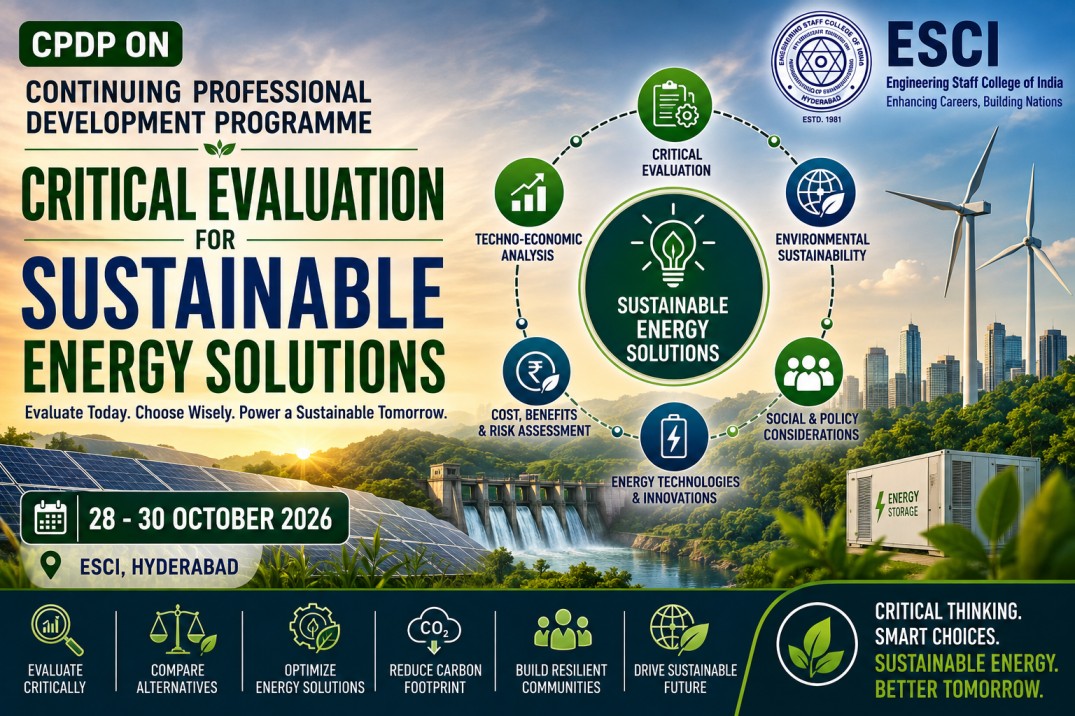
10 Critical Evaluation for Sustainable Energy Solutions 8077 28/10/2026 - 30/10/2026 3 Classroom 18500 NA
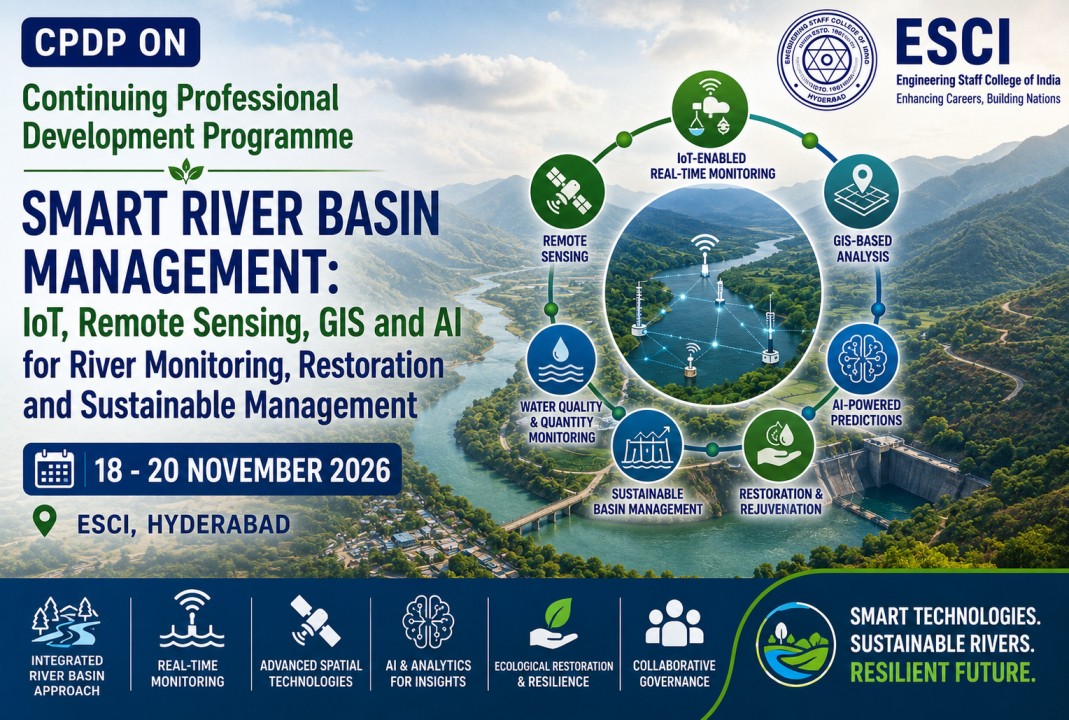
11 Agricultural Practices, Soil Health, and Climate Change: Challenges and Solutions 8078 18/11/2026 - 20/11/2026 3 Classroom 18500 NA
12 Climate Change Impacts on Biodiversity and Ecosystems 8079 16/12/2026 - 18/12/2026 3 Classroom 18500 NA
13 Climate Change and Coastal Hazards 8080 27/01/2027 - 29/01/2027 3 Classroom 18500 NA
14 Impact of Land Use–Land Cover Changes on Urban Lakes 8081 16/02/2027 - 18/02/2027 3 Classroom 18500 NA
15 Urban Heat and Flood Risks in a Changing Climate 8082 10/03/2027 - 12/03/2027 3 Classroom 18500 NA

JOB DESCRIPTION

CALL US
Office Telephone: +91 40 66304100
Mobile: +91 73373 19038
VISIT OUR CAMPUS
Old Bombay Road, Gachibowli, Hyderabad, Telangana - 500 032, India
SEND MESSAGE
Training & Consulting Queries
info@escihyd.org